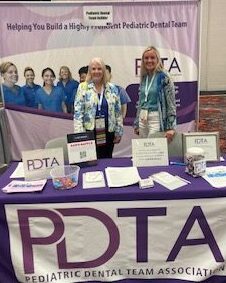
Over the past several months, I’ve had the privilege of speaking with pediatric dentists and their teams in Philadelphia, Myrtle Beach, Orlando, and most recently at the American Academy of Pediatric Dentistry Annual Session in Las Vegas.
One of my favorite parts of attending these meetings isn’t presenting.
It’s listening.
I enjoy meeting new pediatric dentists, reconnecting with colleagues, and visiting with PDTA members who stop by the booth to say hello. Those conversations often provide valuable insight into what is really happening in practices today.
At nearly every meeting, I ask the same question:
“What is the biggest challenge you’re facing in your practice right now?”
This year, one answer came up far more than any other:
Finding experienced team members.
Many doctors shared that they simply cannot find applicants with dental experience. As a result, they are hiring individuals with little or no dental background and training them from the ground up.
The good news?
Some of the best team members I’ve ever worked with started with absolutely no dental experience.
The challenge isn’t hiring them.
The challenge is training them.
Unfortunately, many practices hire a new employee, assign them to the busiest and most experienced person in that department, and hope for the best.
When I ask what onboarding systems, training guides, checklists, or skill assessments they use, the answer is often:
“We really don’t have anything formal.”
That is where frustration begins.
Here are four strategies I shared repeatedly during my conversations with pediatric dentists this year.
1. Start by Identifying the Non-Dental Skills
Before teaching a new employee how to answer the phone, sterilize instruments, schedule patients, or assist chairside, ask yourself:
What non-dental skills are required for this position?
For example:
🟣 Communication skills
🟣 Reliability
🟣 Organization
🟣 Coachability
🟣 Teamwork
🟣Positive attitude
🟣Ability to work with children and parents
Dental skills can be taught.
Attitude, work ethic, and people skills are much harder to teach.
Hiring the right person often matters more than hiring the experienced person.
2. Create a Roadmap for Training
Many practices train from memory rather than from a plan.
That approach leads to inconsistency and gaps in training.
Instead, create a clear roadmap that outlines exactly what the employee needs to learn.
This may include:
🟣 Position-specific training checklists
🟣 Skills assessments
🟣 Progress tracking forms
🟣 Equipment maintenance responsibilities
🟣 Clinical and administrative competencies
When expectations are clearly documented, both the trainer and the new employee know what success looks like.
3. Involve the Entire Team
One of the biggest mistakes I see is assigning all training responsibility to one person.
While that individual may be highly skilled, they are often already carrying a full workload.
Training becomes more effective when multiple team members participate.
Not only does the new employee receive different perspectives and expertise, but they also begin building relationships throughout the practice.
These connections help new employees feel welcomed, supported, and part of the team more quickly.
The stronger those early relationships become, the faster a new employee integrates into the practice culture and the more likely they are to enjoy their job and remain with the practice long-term.
4. Formalize Your Onboarding Process
The most successful practices don’t leave onboarding to chance.
They develop a repeatable process that can be used every time a new employee joins the team.
A structured onboarding process may include:
🟣 New hire checklists
🟣 Training timelines
🟣 Performance evaluations
🟣 Written procedures
🟣 Skills verification
🟣 Regular progress reviews
This structure reduces confusion, shortens the learning curve, and helps new employees become productive more quickly.
The Bigger Picture
While hiring and onboarding were the most common concerns I heard this year, they are only one piece of building a successful pediatric dental practice.
Communication, leadership development, accountability, systems implementation, patient experience, parent communication, and team culture all play important roles in creating a thriving practice.
The reality is that most pediatric dentists were never formally taught how to recruit, onboard, train, and develop team members.
Yet those skills often determine whether a practice struggles or thrives.
The practices that consistently succeed are not necessarily the ones with the most experienced employees.
They are the ones with the clearest systems.
Because when expectations are clear, training is structured, and team members feel supported, practices run more smoothly, team morale improves, and doctors experience far less stress and frustration.
And that’s something every pediatric dentist can appreciate.
Want More Practical Ideas for Your Practice?
Take a closer look at your practice with our complimentary Pediatric Dental Practice Profitability Guide and discover practical strategies you can evaluate and adapt to strengthen your practice, improve consistency, and increase profitability.
Get Your FREE Profitability Guide

Dr. Rhea Haugseth has spent nearly five decades helping pediatric dental practices build exceptional teams.
As a pediatric dentist, practice owner, educator, speaker, and past President of the American Academy of Pediatric Dentistry, she has learned that successful practices are built through confident teams, strong leadership, and proven systems—not by chance.
She is the founder of the Pediatric Dental Team Association (PDTA) and the Atlanta Pediatric Dental Assistant School (APDAS), where she continues to develop practical resources, leadership strategies, and training programs designed specifically for pediatric dental practices.
A Diplomate of the American Board of Pediatric Dentistry and past President of the American Academy of Pediatric Dentistry, Dr. Haugseth continues to lecture nationally and practice pediatric dentistry, bringing real-world experience to every PDTA resource she creates.